Hearthlight Updates: Kickstarter Lessons & Chapter 29 Progress
A failed campaign isn't a dead end; it’s a masterclass. Looking back at the numbers from our June Kickstarter, what I learned about audience momentum, and our massive goal for the September 1 relaunch. Plus, a progress update on Chapter 28!
A World Reborn
Looking Back: The June Kickstarter
As many of you know, this past June I took a major leap of faith and launched a Kickstarter campaign to bring the first phase of The Hearthlight Cycle to life. My goal was ambitious, but my belief in this world and this community was—and remains—unshaken. Ultimately, the campaign fell short of its funding goal, closing out with 6 incredible backers and a total of $205 toward our $5,500 target.
To those 6 pioneers who stepped up to back the project: thank you from the bottom of my heart. Seeing names pop up in my inbox during those first few days was an incredible feeling. Your early faith in Aestraea is exactly what keeps me moving forward, and I am deeply grateful for your support.
The Hard Truth & What I Learned
A failed campaign isn't a dead end; it’s a masterclass in publishing. The data from June sent a loud, clear message: audience momentum is everything.
Crowdfunding isn't just about having a great book or a compelling universe; it’s about a highly coordinated launch window. Relying on a small, passionate inner circle to clear a large funding hurdle simply isn't sustainable. To make this project a reality, the strategy has to shift entirely from launching and hoping to preparing and knowing.
Moving forward, I'm setting a strict prerequisite before the next campaign goes live. We need to hit a milestone of 100 to 150 subscribers on the Kickstarter "Notify Me" pre-launch page before September 1. This is the critical mass required to signal to Kickstarter’s algorithms that our project is worth paying attention to on Day One.
The Next Steps: Goals for August & September
We aren't throwing in the towel; we are recalibrating the entire engine. Here is how the next two months look behind the scenes:
August Focus (Building the Foundation): This entire month is dedicated to pre-launch visibility. I will be pulling back the curtain on Aestraea more than ever before, sharing exclusive lore, behind-the-scenes worldbuilding, and character reveals. The sole goal of this content is to drive readers to the "Notify Me" button so we can secure our 100–150-backer foundation.
September 1 Relaunch: Mark your calendars. With a refined strategy, a built-in crowd, and a clear vision, The Hearthlight Cycle returns to Kickstarter on September 1.
Writing Update: The Hearthlight Cycle
Coming to Kickstarter September 1:
A World Reborn returns to Kickstarter on September 1, with the goal of having 100-150 pre-launch backers. Will
While the business and marketing side of indie publishing has its steep learning curves, the creative side is absolutely thriving. I am currently deep in the trenches of Chapter 29 of the manuscript.
The finish line for this specific arc is finally coming into focus. I have roughly 10 chapters left to write before the first full draft is complete. Watching these characters evolve and seeing the plot threads weave together has been incredibly fulfilling, and it makes me more determined than ever to get this book into your hands in its best possible form.
Thank you all for walking this road with me through the peaks and the valleys. Your support—whether it's backing a project, reading this blog, or sending an encouraging note—is what keeps Aestraea alive.
The new pre-launch page will be live soon. Let’s hit that 100–150 goal together and make September 1 unforgettable!
Etymology of the Aestraean Menu
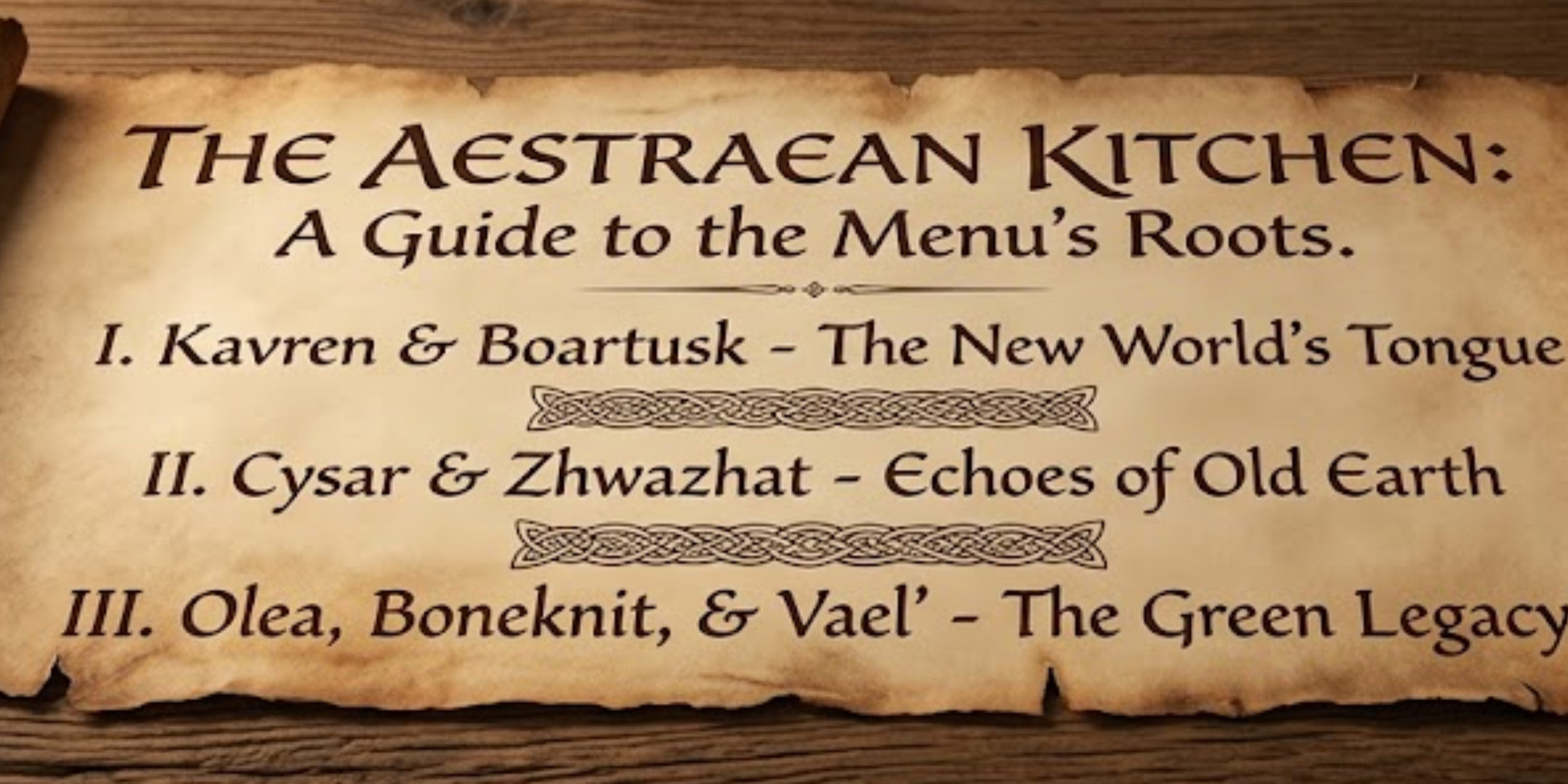
Behind the culinary landscape of Aestraea lies a deeper linguistic history. Discover how real-world ancient trade routes, botanical folklore, and a lot of kitchen experimentation shaped the flavors—and the names—on Marleigh’s menu.
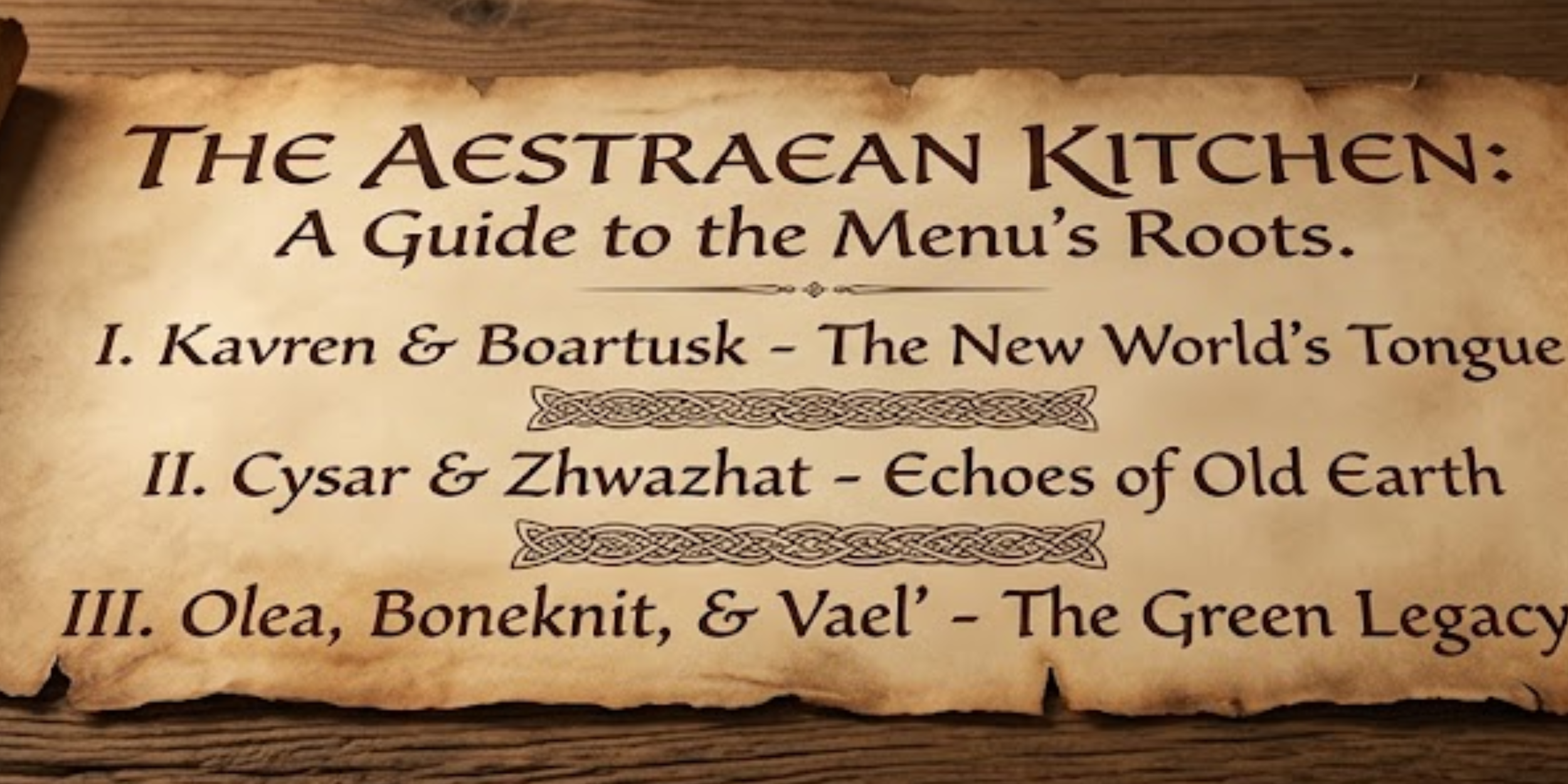
When building the culinary landscape of Aestraea, I quickly realized that food is one of the most powerful ways to anchor a reader. But it presents a unique worldbuilding challenge: When do you invent an entirely new word, and when do you reach back into our own history to let real-world language do the heavy lifting?
In Aestraea’s kitchens, the menu is split cleanly down the middle between words born of this new world and words resurrected from our oldest roots.
Part I: The Words Born of Necessity
Two things in Aestraea's kitchen required entirely new words because nothing on Earth had ever made them before. They couldn't borrow existing reputations; they had to build their own, one wince or one hunt at a time.
Kavren (The Black Brew)
Served pitch-black in Marleigh’s kitchen, kavren is the first of these new words. When she first discovered the beans, they yielded a harsh, unapologetically bitter brew that left patrons grimacing. But Marleigh didn't give up on it; she spent weeks experimenting with roast times, tracking the exact moment when the heat's harshness, unlocking a smooth flavor profile.

Kavren & Cream
Typically, bitter, cream, and honey tame the bitterness, making the drink slightly more palatable to those with sensitivities to bitter.
To complement her new roast, she introduced a whole line of house-made creams, ranging from rich and plain to heavily infused. Now, ordering kavren is a local pastime, with regulars discovering they can mix different creams for entirely new flavor profiles. Riordan, for instance, has a known weakness for layering her chocolate and peppermint creams into his mug, a small, comforting luxury in a dangerous world. Because Kavren didn't inherit coffee's modern, ready-made reputation, the characters (and the readers) get to watch its culture be built from scratch, one experiment at a time.
Boartusk
The second is the boartusk. Larger than a standard boar but smaller than whatever Mirodan's people call a bölény, this beast provides Aestraea with its meat, its bacon, and its leather. It also provides a running argument about exactly how many boartusk Mirodan can talk someone into hunting on a single trip. It’s an animal of profound utility and weight; Riordan always thanks the animal before he touches it, placing a hand on its shoulder, a debt acknowledged before it is spent.
Neither word existed before this world explicitly needed it. Everything else? I only had to remember.
Part II: The Words Borne of History
Everything else on the menu is much older than it looks. Rather than inventing alien phonetics for the sake of it, I chose to look back at the linguistic footprints of ancient Earth.
Cysar (The Golden Pour)
Our cyser is a traditional real-world cyser. In standard cider-making, apples ferment on their own; in traditional mead, honey ferments in water. A cyser is the beautiful intersection where honey ferments directly alongside apple juice. Because they share the same barrel from day one, the sweetness and the fruit forge entirely separate identities in the same cup.
Zhwazhat (The Ghostly Fruit)
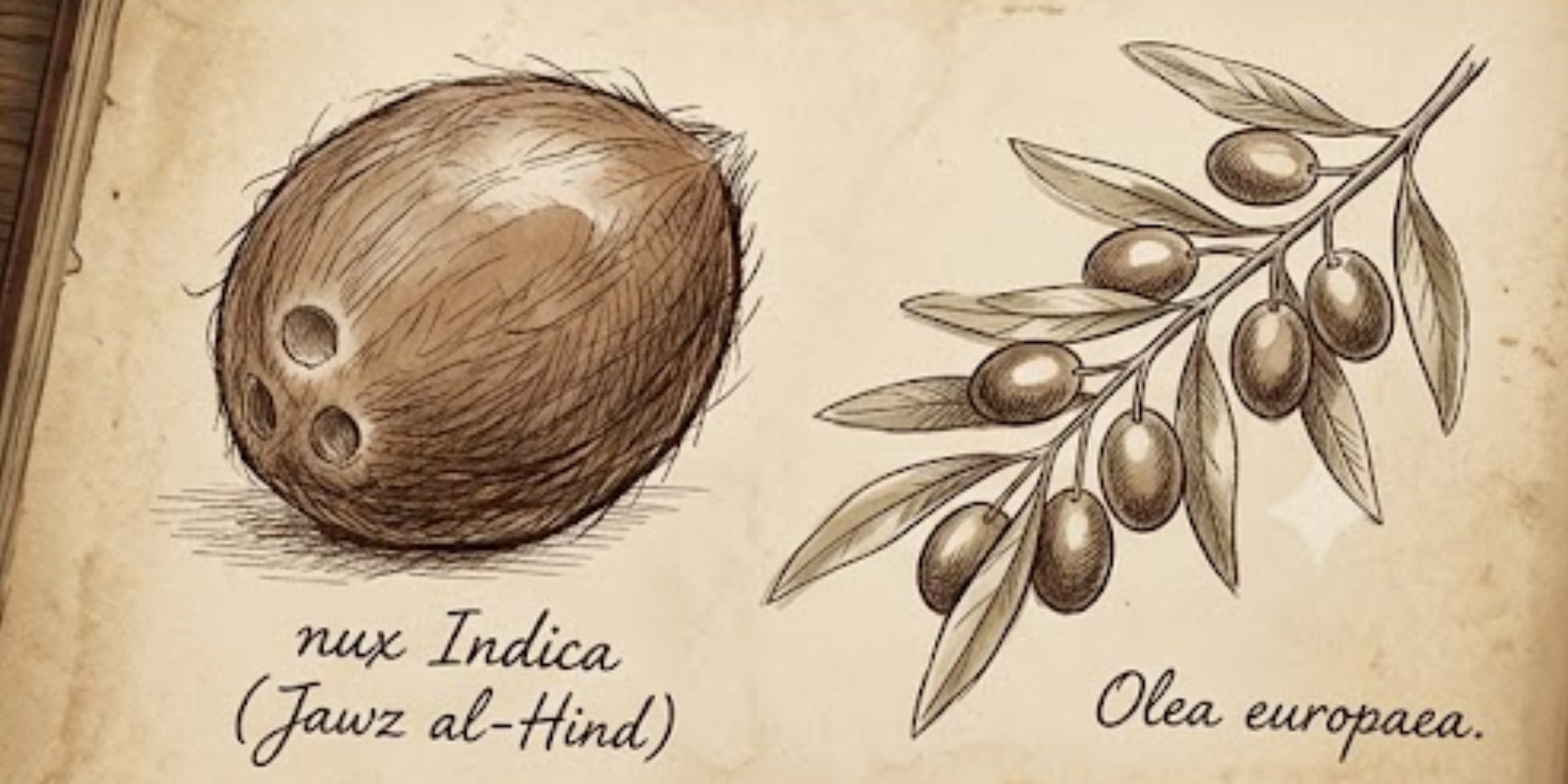
This is where the real-world spice routes bleed directly into Aestraea. Zhwazhat is adapted from Jawz al-Hind (جوز الهند), the historical Arabic name meaning "Nut of India." It is a linguistic fossil from the ancient Indian Ocean trade routes, from an era when early explorers like Marco Polo first documented the fruit in the thirteenth century and mistakenly assumed it originated solely on the Indian subcontinent.
Zhwazhat & Olea
Zhwazhat al-hind translates to walnut of India, and is one of the older terms used for the humble coconut. It was in the 16th Century that the Portuguese began calling it a “coconut.”
It was a globe-spanning term used for hundreds of years before Portuguese sailors finally settled the matter with "coco,” their word for a grinning ghost or goblin, inspired by the three eerie, face-like spots on the shell. In the real world, the older trade names quietly lost the argument. In Aestraea, the ancient name survived.
Olea & Boneknit (The Botanical Heritage)
Olea: Steps straight out of classical Latin. It is the direct, untouched genus of the olive tree, left alone rather than reinvented because the classical weight of the word already feels timeless.
Boneknit: This is simply comfrey by its old, working folk-name. Long before modern medicine, traditional herbalists relied on the plant to heal fractures, affectionately calling it "knitbone" or "boneset" because they expected it to knit a fracture back together literally.
The Everyday Green: Tubers, Karota, and Aepfel
The basic crops follow a similar linguistic drift:
Tubers remain our reliable potatoes.
Karota are our carrots.
Aepfels are apples. For a long stretch of history, æppel was just the Old English word used generally for any round fruit or nut (which is why we still have words like pineapple). Eventually, English narrowed its focus down to a single tree, but Aestraea keeps the broader, older memory alive.
Even Capsicas (peppers) and Tettnanger Lager follow the old ways, the lager being named exactly as beers have been named for centuries, after the noble hops harvested in medieval Europe long before anyone in Aestraea ever poured a glass.
Part III: Bridging the Gap
Vael'Capsicas sits directly in the middle of all this, with one foot in history and one foot in Aestraea.
Capsicas is the old world doing what it has always done, maintaining its botanical roots. Vael' is entirely mine, a prefix that exists nowhere but here. Together, they form a hybrid language to create a pepper that earns its terrifying warning long before anyone reaches for it. I built Vael' because this world eventually needed a word that hot.

What is The Hearthlight Cycle & Where Do I Start?
Seven books. One original world. An ensemble cast navigating ancient dragons, warring nations, and the fear of what cannot be known. Start with A World Reborn.
What is The Hearthlight Cycle and Where Do I Start?
As with many adventures, it is best to start at the beginning; and for The Hearthlight Cycle, the beginning is A World Reborn.
The Hearthlight Cycle is a seven-book epic fantasy series set in Aestraea, an original world created by C.N. Mackey and published by Map's Edge Media. It follows an ensemble cast across a world shaped by ancient dragons, warring nations, and the remnants of a forgotten age. It is epic fantasy with psychological depth, morally complex characters, and prose that reads as poetry.
You start with A World Reborn. That is Book 1, and it is the intended entry point. The series is sequential. Each book builds on what came before. There is no good reason to read them out of order, and several good reasons not to.
A World Reborn is currently being crowdfunded on Kickstarter. The campaign runs through 30 June 2026. After that, a standard edition will be available through Map's Edge Media.
If you want to be inside the world before the book is finished, the Map's Edge newsletter on Substack is where that happens. Lore, character insights, behind-the-scenes writing, and everything happening with the series as it develops. It is free. It is where readers find the door first.
The full series runs seven books, from A World Reborn through A New Age. It is worth it.